Reference Architecture: A Real-World Enterprise Agent Platform
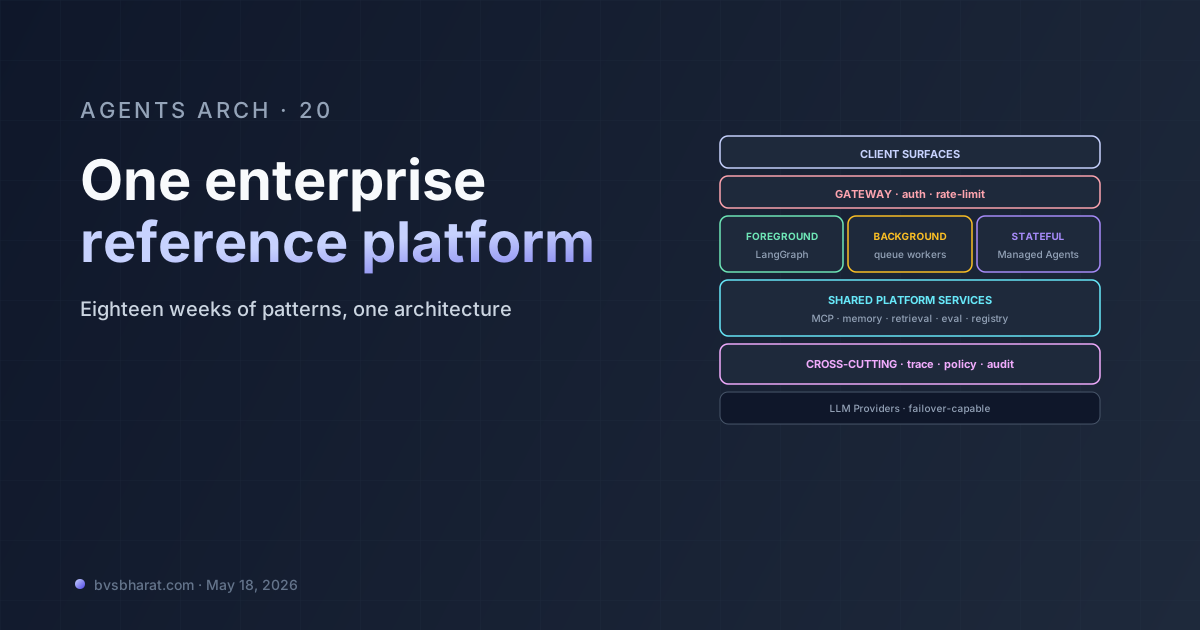
After eighteen weeks of pieces — agent anatomy, frameworks, memory, tools, observability, deploy, cost, security, governance, multi-agent — this post puts them together. One architecture, one repo layout, the contracts between components. Not the “right” architecture, but a coherent one that draws on everything the series covered.
The shape is what a thoughtful organization actually builds in 2026. Real teams will diverge on specific choices (managed vs DIY runtime, framework selection, queue technology). The skeleton is the same.
The diagram
Top to bottom:
- Client surfaces — wherever agents get invoked. Web, Slack, API, CLI, internal workflows.
- Gateway — authn/authz, rate limiting, tenant scoping, request shaping. The boundary where actor identity is established.
- Three agent lanes — foreground (request/response), background (queue-driven workers), long-running stateful (multi-step / HITL). Each lane has its own deployment shape and autoscale signal.
- Shared platform services — MCP servers (tools), memory store, retrieval (hybrid), eval pipeline, agent registry.
- Cross-cutting — tracing, policy, credentials, audit. Touches every other component.
- LLM providers — at the bottom because they’re a dependency, not a product surface. Multi-provider failover.
The repo layout
What the monorepo for this looks like:
/agents-platform
├── /agents                          # one folder per agent
│   ├── /billing-resolver
│   │   ├── agent.py                 # LangGraph or CrewAI definition
│   │   ├── agent_card.yaml          # A2A capability card
│   │   ├── policy.rego              # OPA policy
│   │   ├── tools.py                 # tool implementations
│   │   ├── prompts/
│   │   ├── evals/
│   │   │   ├── golden.jsonl
│   │   │   └── trajectory_specs.yaml
│   │   └── README.md
│   ├── /research-writer-crew        # multi-agent crew
│   └── /...
│
├── /mcp-servers                     # shared tool surfaces
│   ├── /billing
│   ├── /knowledge-base
│   └── /...
│
├── /platform
│   ├── /gateway                     # FastAPI app for entry points
│   ├── /runtime                     # shared agent runtime helpers
│   │   ├── tracing.py
│   │   ├── policy.py
│   │   └── credentials.py
│   ├── /memory                      # memory store client
│   ├── /retrieval                   # hybrid retriever
│   └── /eval                        # eval harness
│
├── /infra
│   ├── /terraform
│   ├── /helm                        # k8s charts
│   └── /managed-agents              # Anthropic / AgentCore configs
│
├── /docs
│   ├── architecture.md
│   ├── runbooks/
│   └── decision-records/
│
└── /.github
    └── /workflows
        ├── agent-eval.yml
        ├── policy-test.yml
        └── deploy.yml
Two patterns this layout enforces:
- One agent per directory, self-contained. Definition, policy, tools, evals, README all colocated. A new engineer can open
/agents/billing-resolverand understand the agent from one folder. - Shared infrastructure in
/platform. Tracing, policy enforcement, credential injection — used by every agent, owned by the platform team, not duplicated per agent.
The contracts
The interfaces that keep the system maintainable:
Agent ↔ Runtime
Every agent exposes:
class AgentInterface:
    name: str
    version: str
    agent_card: AgentCard

    async def invoke(input: AgentInput, context: AgentContext) -> AgentOutput: ...
    async def resume(thread_id: str, signal: Any) -> AgentOutput: ...
The runtime can run any agent that implements this; the agent doesn’t know what runtime is calling it.
Agent ↔ Tool
Tools are MCP-shaped or LangChain-shaped (both are loadable). Tool schemas live with the tool, not in the agent. The agent imports tools by name from the registry.
Agent ↔ Memory
A typed memory API that wraps the hybrid retriever and the long-term store:
class MemoryAPI:
    async def remember(content: str, kind: MemoryKind, owner: str, **meta) -> str
    async def recall(query: str, owner: str, k: int = 8, kind: MemoryKind | None = None) -> list[Memory]
    async def consolidate(owner: str, window: timedelta) -> ConsolidationResult
Same API across agents; backed by the platform’s memory store.
Agent ↔ Policy
Every tool call passes through the policy check:
decision = await policy.check(
    agent=self.name,
    tool=tool_name,
    args=tool_args,
    actor=context.actor,
)
match decision:
    case PolicyAllow():
        result = await tool.invoke(**tool_args)
    case PolicyRequireApproval(reason):
        return await self.request_approval(tool_name, tool_args, reason)
    case PolicyDeny(reason):
        raise PolicyDenied(reason)
The policy is rego; the runtime helper does the call. Every agent uses the same helper; nobody bypasses it.
Agent ↔ Observability
Tracing is automatic — the framework’s spans plus OTel context propagated through tools. The audit log is not the same as the trace; tool executions that mutate state write a separate audit event.
The migration sequence
If you’re building this from scratch, the sequence that maps to where the value lands:
- Week 1–2: one foreground agent, traced. LangGraph or Managed Agents. Tracing on. Simple golden eval set.
- Week 3–4: MCP server for the first real tool surface. Move tool definitions out of the agent into a server. Connect from the agent.
- Week 5–6: memory store. Hybrid retriever, session+long-term shapes. Cross-session continuity is the first user-visible quality leap.
- Week 7–8: policy and audit. OPA, audit log table, gateway plumbs actor identity through. This is the first “safe for sensitive data” milestone.
- Week 9–10: background lane. Queue, worker pool, retry/DLQ. Now you can ship batch use cases.
- Week 11–12: HITL. Long-running stateful lane, interrupt/resume, approval workflow.
- Week 13–14: eval gate. Layer the trajectory grading on PR checks. Cost/latency dashboards. Regression gates.
- Week 15–16: second agent, reusing platform. Validate the platform scales beyond one agent.
A team of 3–4 engineers can hit this sequence in a quarter, plus or minus. The “magic” comes from steps 5–8; the foundation comes from steps 1–4.
Where teams get this wrong
The failure patterns I see most often:
- Building the platform before the first agent. You don’t know what the platform needs until one agent is in production. Build for the agent in front of you; refactor when the second one comes along.
- No actor identity plumbing. Adding “who is this on behalf of” late is painful. Plumb actor through from day one even if your first agent doesn’t need it.
- Trace and audit conflated. Operational tracing is sampled and ephemeral. Audit is immutable and complete. Use different stores.
- Per-agent reinvention. Every team writes their own retry logic, their own credential injection, their own context truncation. Put it in
/platform. - Skipping evals. “We’ll add evals later.” You won’t, and you’ll ship regressions in the meantime.
What this architecture is not
It’s not a perfect architecture — it’s a coherent one. Specific trade-offs to be aware of:
- It’s framework-pluralist by design. Some teams will prefer a single-framework house and gain simplicity at the cost of flexibility.
- It’s eventually consistent in audit. Audit events emit asynchronously to the audit log; if the audit log is unreachable, the action still happens. Adjust if your compliance regime requires synchronous audit.
- It’s biased toward managed runtimes. A team with strong platform engineering may prefer everything on k8s. The shape is the same; the lanes swap implementations.
- The retriever is shared across agents. Some workloads need per-tenant retrievers; partition accordingly.
What’s next
Twenty weeks in, the architecture is largely a known quantity. Next week, the last post in the series: where agent architectures go from here. What 2026 didn’t solve, what the research is suggesting, and the bets that look most promising for the next year of agent engineering.