About
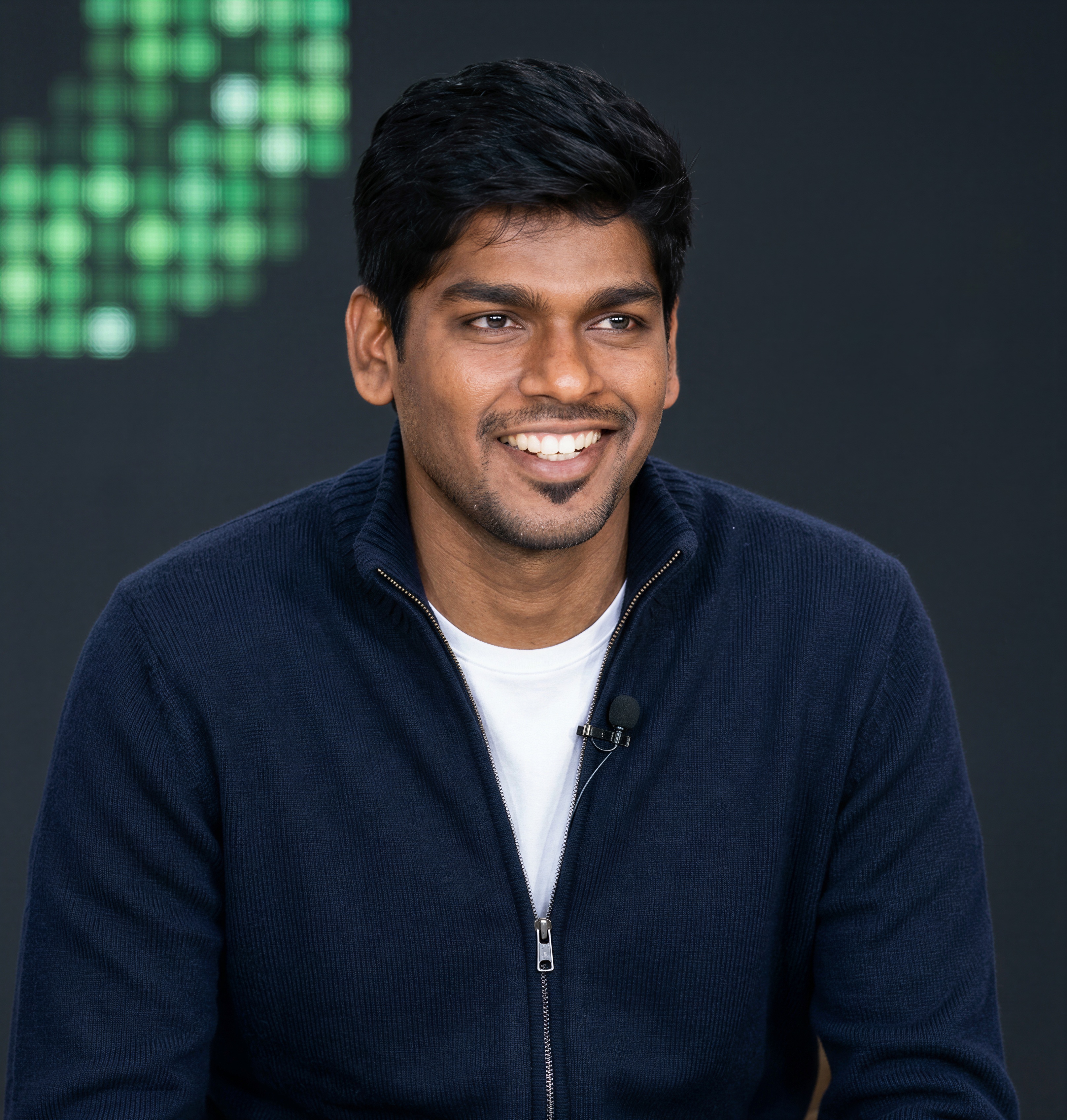
I build AI agents for enterprise — agents that think, decide, and act across full business workflows. 15 years of shipping production web applications, the last 3 years inside the agent stack: harnesses, tool loops, memory layers, orchestration. Right now aimed at insurance — rewriting a century-old machinery of forms and phone calls into code that talks back.
I architect voice-native and event-driven agents spanning the full lifecycle: quote, underwriting, policy, billing, claims intake, triage, settlement — through a shared orchestration layer with persistent memory, sub-500ms voice latency, and guardrails that hold when models drift. Two patents filed in the AI agent architecture space — reimagining how agents live inside web and voice applications.
What I obsess over lives below the marketing layer: harnesses that survive long-horizon tasks, multi-agent handoffs that preserve context, client-side tool execution that skips MCP round-trips when latency matters, barge-in and turn-taking that feel human on flaky networks, evals that catch silent regressions, and fallback chains that degrade gracefully instead of catastrophically. I care about the choreography between the planner and the executor, the memory hierarchy that keeps a 20-turn conversation coherent, and the boring infrastructure — observability, replay, deterministic harnesses — that turns prototypes into systems enterprises can bet on.
If you’re designing agentic systems for regulated industries, scaling LLM workflows in production, or rethinking insurance from quote to claim — let’s build. 🤝
San Francisco, CA • 30+ Hackathon Wins
Experience
Sr Software Engineer / AI Agent Developer Guidewire Software, San Mateo, CA • April 2019 – Present (7 years)
- Leading development of next-gen Multi-Agent Systems for conversational claim processing using Livekit, Mastra, LangChain/LangGraph
- Building production voice agents with LiveKit, achieving natural conversational experiences with SSML-driven disfluency patterns and real-time streaming
- Deployed multi-agent systems achieving 90% pilot subscription rate, now extending into voice-first claim intake workflows
- Built backend infrastructure with autopilot claim processing, significantly reducing call center workload
- Integrated multiple LLMs (OpenAI, Anthropic) with orchestration frameworks for advanced agent workflows
- Implemented RAG with LlamaIndex, Neo4j, Pinecone, and pgvector for dynamic agent information access
Software Consultant — Team Lead Deloitte Consulting, Columbus, USA • April 2016 – March 2019 (3 years)
- Delivered enterprise solutions for Fortune 500 clients, leading cross-functional teams of 15+ developers
- Architected scalable web applications improving client operational efficiency by 45%
- Built SPAs serving 100K+ users, achieving 60% reduction in page load times
Software Engineer ValueLabs, Hyderabad, India • May 2015 – April 2016
Software Engineer Kantar TNS, Hyderabad, India • May 2013 – April 2015
Current Projects
- ClaimVoice — Voice agent platform for insurance — real-time claim intake, policy Q&A, and agent-assisted workflows powered by LiveKit and multi-agent orchestration
- VoiceInk — Voice-to-text app for macOS with real-time transcription
- open-agent-sdks — SDKs for building agentic applications
- agent-builder-hacka — Agent patterns and orchestration toolkit
- SleekVoice — Voice AI framework for conversational experiences
- Commander — AI-powered Mac command center for developer productivity
Technical Skills
AI/ML: LangChain, LangGraph, Mastra, CrewAI, Neo4j, LlamaIndex, LiveKit, MCP, PyTorch
Languages: TypeScript, JavaScript, Python, Node.js, Swift
Frameworks: Next.js, React, Angular, React Native, Tailwind CSS, FastAPI
Databases: Pinecone, Supabase, MongoDB, PostgreSQL, pgvector
DevOps: Docker, Kubernetes, AWS Bedrock, CI/CD Pipelines
Agentic UX Advisor
Advising 4+ early-stage AI startups across the Bay Area on building products where AI agents are the interface — not just the backend.
Most teams building agentic products hit the same wall: the AI works, but the user experience falls apart. Agents that feel robotic, multi-step workflows that lose context, voice interfaces that sound like text read aloud, and conversational flows that confuse instead of guide. This is the gap I help close.
What I bring to the table:
- Voice agent UX — Designing conversational flows that feel human: pause patterns, disfluency engineering, emotion guardrails, and personality-as-behavior prompting. Turning cascaded pipelines (STT → LLM → TTS) into experiences users actually trust.
- Multi-agent interaction design — How to surface agent reasoning without overwhelming users. When to show the “thinking” state, how to handle agent handoffs gracefully, and designing fallback flows that don’t break immersion.
- Agentic workflow patterns — Structuring agent-driven products around human decision points. Not everything should be autonomous — the best agentic UX knows when to act, when to suggest, and when to ask.
- Product-level prompt architecture — System prompt design that scales across user personas, edge cases, and evolving product requirements. Moving beyond one-off prompt tweaks to systematic prompt infrastructure.
How I work with startups:
I embed with founding teams during critical product phases — pre-launch UX reviews, voice agent tuning sprints, and user testing cycles. The goal is always the same: make the agent experience feel like a product, not a demo. I help teams move from “the AI can do this” to “users actually want to use this.”
If you’re building an agentic product and the UX isn’t landing, reach out.