Cascaded vs Fused Voice Agents: A Builder's Perspective on Architecture Choices
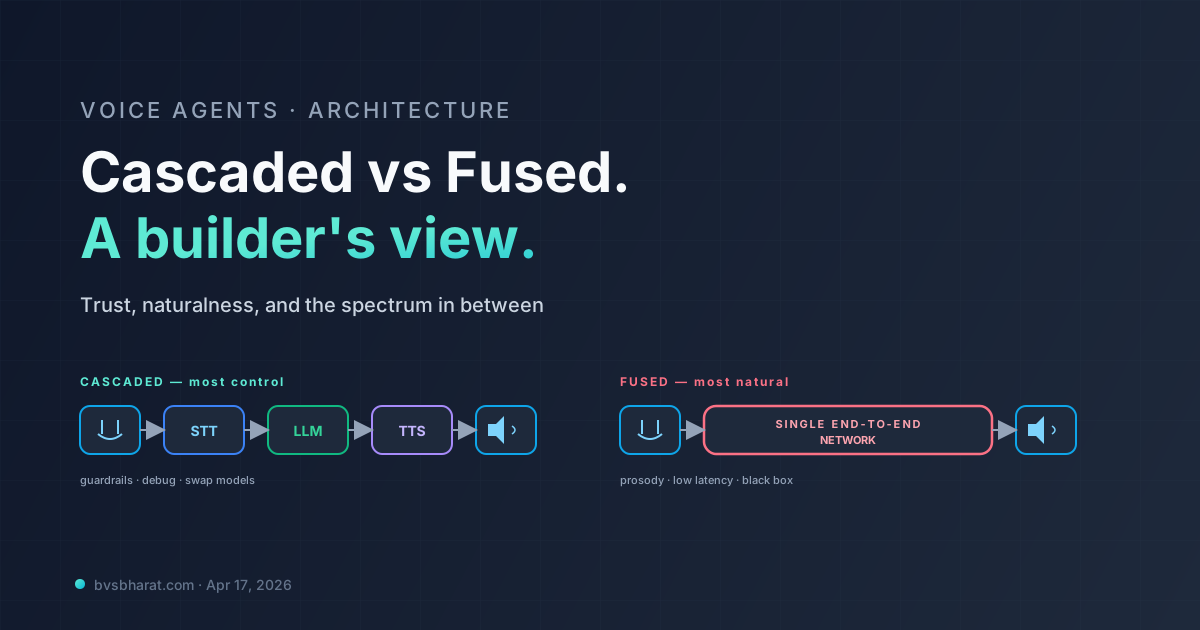
Cascaded vs Fused Voice Agents: A Builder’s Perspective on Architecture Choices
There’s a lot of hype around “conversational AI” right now. But the quality of a voice agent depends almost entirely on one fundamental decision: how do you wire the pieces together?
Should speech recognition, reasoning, and generation happen in sequence (cascaded)? Or should they run inside a single neural network (fused)? That choice determines whether your agent sounds human, can be trusted, and can actually solve problems.
I’ve spent the last 18 months shipping voice agents to production. Here’s what I’ve learned about these architectures—and why the choice isn’t as binary as it seems.
The Spectrum, Not the Binary
Most discussions frame this as a two-choice problem. But in reality, there are at least five distinct architectures, and teams that ship well understand the tradeoffs clearly.
Basic Cascaded: Simple & Transparent
What works:
- Full transparency. You can read what the LLM saw. You can inspect what it decided to say.
- Guardrails at the text layer. You can enforce compliance rules, block certain outputs, add context.
- Model flexibility. Want a better reasoning model? Swap it in. New TTS that sounds better? Update it independently.
What doesn’t:
- Flatness. Without context about the user’s tone, emotion, or emphasis, the LLM can’t adapt its response. The agent sounds functional but emotionless.
- Turn-taking is awkward. The system doesn’t know when to interrupt, when to listen, when to pause naturally.
Good for:
- IVR replacements (telecom, utilities)
- FAQ handling and support bots
- Notifications and reminders where consistency beats personality
Advanced Cascaded: Where We Live Now
This is what we’re actually building in production at scale.
The STT model doesn’t just convert words—it sends emotional context, tone markers, stress patterns to the LLM. The LLM understands not just what was said, but how it was said. It can respond with instructions like “speak warmly,” “be urgent,” “acknowledge frustration.”
The TTS gets those instructions and adapts dynamically across the conversation.
Advantages:
- Natural sounding with full control
- All the transparency and guardrails of cascaded
- Access to frontier reasoning models
- Intelligible turn-taking based on actual signals
Challenges:
- Requires co-optimization of three separate models
- Context passing between layers adds latency (though modern infra solves this)
- Building the “instruction language” between LLM and TTS takes work
Great for:
- Financial services (empathy + compliance)
- Healthcare (warmth + precision)
- Sales (persuasion + script adherence)
Hybrid: Fusing Only Where It Matters
Some teams fuse the STT and LLM layers—passing acoustic embeddings instead of text—while keeping TTS modular.
The case for it: If an emotion signal needs to flow into the LLM quickly, embeddings are faster than text layers.
The case against it:
- You lose the ability to swap LLMs. You’re locked into whatever model the ASR+LLM fusion was built with.
- Embeddings aren’t human-readable. Good luck debugging.
- As soon as you want a stronger reasoning model, you’re rebuilding.
Sequential Fused: OpenAI’s Realtime Approach
<circle cx="60" cy="40" r="30" fill="#1e293b" stroke="#a78bfa" stroke-width="2.5"/>
<text x="60" y="46" text-anchor="middle" fill="#c4b5fd" font-weight="700" font-size="13">STT</text>

<circle cx="220" cy="40" r="32" fill="#1e293b" stroke="#a78bfa" stroke-width="2.5"/>
<text x="220" y="46" text-anchor="middle" fill="#c4b5fd" font-weight="700" font-size="14">LLM</text>

<circle cx="380" cy="40" r="30" fill="#1e293b" stroke="#a78bfa" stroke-width="2.5"/>
<text x="380" y="46" text-anchor="middle" fill="#c4b5fd" font-weight="700" font-size="13">TTS</text>One model handles everything. Audio in, audio out.
Why people love it:
- Prosody. Because speech never converts to text, it preserves pacing, emotion, intonation naturally.
- Brief conversations feel incredibly fluid.
- Low latency between turns.
Why it breaks at scale:
- No guardrails. You can’t enforce compliance rules at a text layer because there is no text layer.
- Weak reasoning. Fitting ASR, reasoning, and generation into one model means each component is lighter-weight. You get worse tool-calling, worse problem-solving.
- No debugging. When it fails, why did it fail? You have no idea. Black box.
- No component updates. A better reasoning model ships? Too bad. You’re stuck with the entire fused network.
We tested this approach internally. For 2-3 minute conversations with simple back-and-forth, it’s genuinely impressive. But the moment you ask it to reason about a complex problem, handle compliance guardrails, or debug a failure—it falls apart.
Duplex Fused: The Frontier
Input and output happen at the same time. The model listens and speaks overlapping. Very Google Duplex.
When it’s great:
- Overlapping speech and natural turn interruptions can feel very human.
When it’s a nightmare:
- Impossible to control. Crosstalk errors are unpredictable.
- Zero transparency. Complete black box.
- Instability in longer conversations. The more you talk, the more errors accumulate.
Honest assessment: Experimental. Not production-ready for anything with stakes.
What We Built & Why
After shipping agents to governments, financial institutions, and healthcare providers, we standardized on Advanced Cascaded because:
-
Trust. Text layers let us implement guardrails that actually work. Our system can’t accidentally violate compliance—the rules are at the layer where decisions happen.
-
Upgradeability. When a new frontier LLM ships, we integrate it in days. We’re not waiting for someone to rebuild a fused network.
-
Quality. Emotion-aware STT + instruction-aware TTS gives us naturalness approaching fused architectures, with 10x more control.
-
Debuggability. When something goes wrong in production, we can see exactly what happened at each stage.
-
Domain optimization. We fine-tune STT for healthcare jargon, legal terminology, etc. You can’t do that in a fused model.
The Decision Framework
Here’s how we actually choose:
| Criteria | Cascaded | Fused |
|---|---|---|
| Reasoning complexity | ✅ Excellent (frontier models) | ⚠️ Medium (lighter-weight) |
| Compliance/Guardrails | ✅ Full control | ❌ Very limited |
| Natural prosody | ✅ Getting there (with tuning) | ✅✅ Native |
| Latency | ✅ Low (co-located stack) | ✅ Very low |
| Debuggability | ✅ Full visibility | ❌ Black box |
| Component swapping | ✅ Easy | ❌ Impossible |
| Production reliability | ✅ Proven at scale | ⚠️ Unpredictable |
What We’re Watching
Distilled fused models. If someone figures out how to compress a 70B reasoning model into a fused architecture without losing capability, that changes the game. We’re not there yet.
Speculative prosody. Can we predict prosody variations from text tokens before TTS runs? This could close the naturalness gap further.
Adaptive guardrails. Enforcing guardrails within a fused architecture without a text layer. It’s mathematically possible but no one’s cracked it yet.
The Honest Take
Fused models get impressive demos. They’re good marketing. But they’re not enterprise-ready. The moment you need to comply with regulations, reason through a complex problem, or debug a failure in production—you need cascaded.
Cascaded architectures are architecturally boring but fundamentally more powerful. They’re what gets deployed at organizations where failure isn’t acceptable.
The future probably isn’t a binary choice. It’s hybrid systems that fuse selectively (emotions + reasoning in some cases, voice synthesis separately) while maintaining transparency and control where it matters.
For now: if you’re building something that has to work, go cascaded. If you’re building a demo, fused is more impressive.
Building voice agents is hard. I’m learning in public. If you’re shipping in this space, I want to hear what architectures you’ve tried and what worked.