The Future of Agent Architectures: 2026 and Beyond
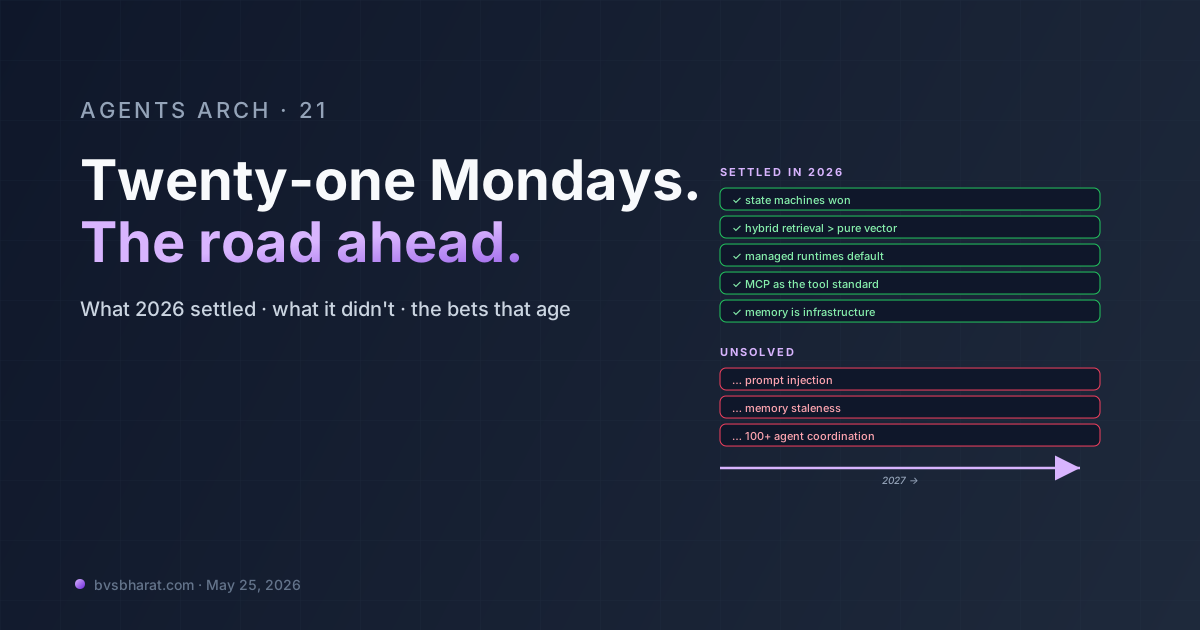
Twenty-one weeks ago this series started with the basic anatomy of an AI agent. Eighteen technical posts and a reference architecture later, the field has moved enough that some of the picks made in Week 1 already feel like history. The framework wars cooled into pluralism. Memory shifted from research curiosity to production primitive. Managed runtimes became the default. MCP and A2A standardized the protocols nobody had a year ago.
This final post is the retrospective and the forecast. Five things 2026 settled, five things it didn’t, and the architectural bets I’d make if I were starting an agent project today knowing what I know now.
Five things 2026 settled
1. State machines won the control-flow argument
The “agent is a thing you prompt and it loops” framing died. Every production framework converged on explicit state machines (LangGraph), declarative workflows (CrewAI Flows, ADK SequentialAgent), or hosted equivalents (Managed Agents). The argument now is about which state machine to write, not whether to write one.
2. Hybrid retrieval beat pure vector search
Vector embeddings remain useful. They are no longer sufficient. The 2026 benchmarks made hybrid retrieval (vector + BM25 + graph, RRF-fused) the default for any serious workload. The lesson is older than it looks — search has always wanted exact and fuzzy matching together — but the agent context made it impossible to ignore.
3. Managed runtimes are the path of least resistance
Claude Managed Agents and Bedrock AgentCore turned “run an agent in production” from a months-long platform project into a credit-card decision. For most teams, building your own runtime is no longer the right default. The exceptions are real (on-prem, custom scheduling, extreme scale) but narrower than they were 18 months ago.
4. MCP became the tool standard
Model Context Protocol crossed 97M downloads in 2026, was adopted by every major AI platform, and is now the de facto vocabulary for tool surfaces. The interoperability story this unlocks — tools you write once and expose to any framework — is the kind of plumbing improvement whose value compounds over years.
5. Memory is infrastructure, not a feature
Cross-session memory is the single biggest UX shift for users who interact with the same agent repeatedly. The pattern (four-tier consolidation, offline reflection, hybrid retrieval) is settled. The platforms shipped it: Anthropic’s Dreaming, AgentCore Memory, Vertex AI Memory. The teams treating memory as “we’ll RAG the chat history later” are visibly behind the ones that built memory as a first-class subsystem.
Five things 2026 didn’t settle
1. Prompt injection
Honest framing: no model is robust to it. The architectural defenses (input separation, capability narrowing, HITL for irreversible actions) bound the blast radius but don’t eliminate the vulnerability. The 2026 mitigation playbook is solid; the underlying problem remains. Watch for: meaningful progress on training-time defenses, formal verification approaches for tool authorization, and the first serious incidents that test whether mitigation is enough.
2. Memory staleness
STALE put a number on it (55.2% best frontier model). No production solution. The principle (write-time consolidation, not read-time filtering) is becoming consensus; the implementations are early. Watch for: structured memory stores that natively support supersession, eval suites that grade staleness directly, and protocols for “this fact is now provably stale” signals between agents.
3. Multi-agent coordination at scale
Hierarchical works for ten agents. The patterns above that — mesh, market, fully decentralized — are mostly research. Production deployments with hundreds of cooperating agents exist (largely behind the scenes at large platforms) but the patterns aren’t generalized into open frameworks yet. Watch for: A2A becoming the de facto coordination layer, the first open-source supervisor-of-supervisors patterns, and meaningful production case studies of >100-agent systems.
4. Cost predictability
You can budget an agent’s cost only to a wide tolerance. Variance is high; tail tasks can cost 50× the median. Caching, tiered routing, retrieval budgets help but don’t bound the tail. Watch for: better hard-limit primitives (provider-level circuit breakers), pricing models that better match agent usage patterns, and the first wave of tools focused specifically on agent cost ops.
5. Evaluation that scales
Trajectory grading, LLM-as-judge, and golden sets are real but labor-intensive. Evaluation hasn’t kept up with deployment velocity. Most teams ship agents with weaker eval coverage than they’d accept for traditional software. Watch for: automated trajectory specification, eval suites generated from production traces, and the first regulators requiring specific eval methodologies.
Three architectural bets for the next year
If I were starting an agent platform today, with no prior code to defend:
Bet 1: Build on MCP from day one
Don’t write tools as Python decorators inside one agent’s repo. Write them as MCP servers from the start. Even if you have one agent today, you’ll have three in six months, and they’ll all need to share the billing API surface. MCP makes that trivial; ad-hoc tool definitions per agent make it a quarter of cleanup work.
Bet 2: Managed runtime, framework-pluralist
Default the runtime to Anthropic Managed Agents or AgentCore. Inside each agent, pick the framework that fits the workload (LangGraph for complex control flow, CrewAI for role workflows, ADK for multi-language teams). The runtime doesn’t need to know which framework you used; the platform stays consistent across agent shapes.
Bet 3: Memory as a service, not a feature
Stand up a memory service that exposes a typed remember/recall/consolidate API, backed by hybrid retrieval, with versioned facts and reflection. Every agent reads and writes through it. Don’t let agents have their own memory stores; the cross-agent memory sharing is where the platform leverage is.
What I’d skip
A few things that look interesting but rarely earn their keep at the current state of the art:
- Custom agent frameworks. The existing ones are good enough. Building your own is rarely a project that pays back, even at large organizations. Use what’s there.
- Truly autonomous long-horizon agents for important work. Hours of unsupervised execution against production systems is not where the technology is reliable. Long-running, yes. Unsupervised, no. HITL stays load-bearing.
- Agent-as-employee framing. Agents are tools. Treating them as employees creates incentive problems (the agent can’t be accountable in a way humans are), confuses governance, and oversells the technology. Useful as marketing, dangerous as architecture.
- Single-vendor platform bets. Even with Managed Agents being attractive, build the abstractions so swapping the runtime is two weeks, not two quarters. Vendor risk is real; the speed of the field is high.
A note on what the technology is for
The series mostly stayed technical. But the question that ages best — “what should we use these for” — deserves a paragraph.
The best 2026 agent deployments share a shape: they take a repetitive, judgment-light task that a human is overqualified for, automate it with appropriate guardrails, and free the human to do work the agent cannot. Customer support triage, code review first-pass, document drafting, research synthesis, ticket routing. The agents that work are the ones that are honest about what they don’t know, escalate cleanly, and produce work a human can verify in seconds rather than reproduce in minutes.
The deployments that fail share a different shape: agents marketed as replacements for senior human judgment, deployed to take actions that are hard to reverse, with no human in the loop, where success is defined as “no one looked.” Those are the ones in postmortems.
The technology will keep getting better. The deployment principle won’t change much: agents are leverage on human capacity, not substitutes for human accountability. Build accordingly.
Thanks for reading
Twenty-one Mondays. Around 75,000 words. A real reference architecture and a lot of diagrams. The goal was to write the series I wish someone had written for me before my first production agent. If a single post saved a team a week of figuring it out themselves, the project earned its keep.
The pieces will keep changing — the frameworks, the protocols, the benchmarks. The architecture, if it’s good, won’t change much. State machines, typed tools, hybrid memory, observable traces, scoped credentials, HITL for irreversible actions, audit logs. These are the load-bearing pieces. Get them right and the rest is implementation detail.
Until the next series — keep your traces, write tests, scope your tools narrow, and trust the human in the loop.
— Bharat