Evaluating Agents: From Unit Tests to LLM-as-Judge Pipelines
The most common production failure for AI agents in 2026 isn’t a crash, a timeout, or an exception. It’s silent quality drift — a prompt change, a model swap, or a retriever tweak that ships clean and degrades behavior in ways the team only notices weeks later through user complaints. The fix is the same as it’s always been for non-deterministic systems: measure.
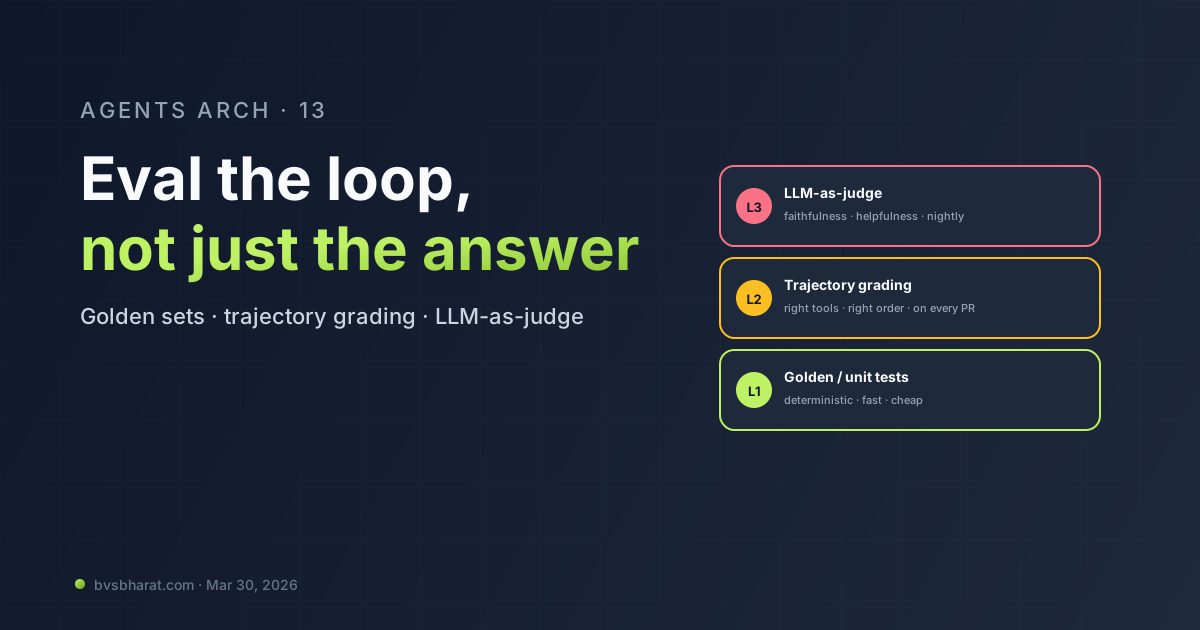
This post is the 2026 evaluation stack. Three layers — unit-level tests, trajectory-level grading, LLM-as-judge with calibration — and the regression gates that put them in front of every change.
What you’re actually measuring
Three orthogonal axes:
- Correctness — did the agent do the right thing? (Outcome-based.)
- Faithfulness — did the agent reason and cite accurately? (Process-based.)
- Cost / latency — was it efficient about it? (Resource-based.)
A change that improves correctness but blows up cost is not an improvement. A change that’s faster but cites hallucinated sources is regression. Track all three; don’t let one axis cannibalize another silently.
Layer 1 is fast and cheap, runs on every PR. Layer 2 catches what unit tests miss. Layer 3 is the slowest and most expensive, runs nightly or on tagged candidates.
Layer 1: unit tests and golden sets
Start here. A golden set is a labeled list of (input, expected_output) pairs. For agents, “expected output” is rarely an exact string — it’s an assertion that something is true about the result.
import pytest

GOLDEN = [
    {
        "id": "duplicate-charge-refund",
        "input": "Customer reports a duplicate charge on INV-2026-0042",
        "assertions": [
            ("tool_call_count", "<=", 4),
            ("must_call", "get_invoice"),
            ("must_call", "list_invoices"),
            ("final_action", "==", "issue_refund"),
            ("must_cite_invoice", "INV-2026-0042"),
        ],
    },
    # ...50 more
]

@pytest.mark.parametrize("case", GOLDEN, ids=lambda c: c["id"])
async def test_agent_case(case):
    trace = await run_agent(case["input"], record_trace=True)
    for assertion in case["assertions"]:
        check(trace, assertion)
The fixture is the agent runner with tracing enabled. The assertions read the trace, not the final text response. This is the difference between brittle and useful — string-matching the final answer breaks on every prompt tweak; asserting “the agent called get_invoice” survives.
Three rules for golden sets:
- Curate, don’t generate. Hand-pick 30–100 cases that span the real distribution. Auto-generated synthetic data is rarely representative.
- Refresh after incidents. Every production bug becomes a golden case. The set grows; the bar rises.
- Don’t optimize only to the golden set. Overfit to the test set and quality drifts in ways the set doesn’t cover. Hold out a portion for sanity checks.
Layer 2: trajectory grading
The trajectory is the sequence of (node, tool, args, result) tuples from the trace. Grading the trajectory means asking: given the input, was this the right path?
@dataclass
class TrajectoryGrade:
    correct_tools_used: bool       # did it call the tools it should?
    no_unnecessary_tools: bool     # did it avoid calls it shouldn't have made?
    reasonable_step_count: bool    # within budget for this kind of task?
    correct_final_action: bool     # final outcome aligns with input intent?

def grade_trajectory(trace: AgentTrace, expected: ExpectedTrajectory) -> TrajectoryGrade:
    actual_tools = [s.attributes["tool.name"] for s in trace.spans if s.kind == "tool"]
    return TrajectoryGrade(
        correct_tools_used=set(expected.required_tools).issubset(actual_tools),
        no_unnecessary_tools=set(actual_tools).issubset(expected.allowed_tools),
        reasonable_step_count=trace.step_count <= expected.max_steps,
        correct_final_action=trace.final_action_kind == expected.final_action_kind,
    )
Trajectory grading is the single most useful eval shape for agents. It’s faster than LLM-judge, more nuanced than unit assertions, and it surfaces “the agent got the right answer for the wrong reason” — a model that reaches a correct conclusion via the wrong tools is one prompt change from giving wrong answers entirely.
Layer 3: LLM-as-judge
The judge is another LLM call grading the agent’s output on dimensions humans can’t easily formalize: helpfulness, tone, faithfulness to sources. The pattern that holds up:
JUDGE_PROMPT = """
You are grading an AI agent's response to a customer support ticket.

INPUT:
{input}

AGENT TRACE (summarized):
{trace_summary}

AGENT FINAL RESPONSE:
{response}

Rate on the following dimensions, integer 1-5. Cite specific evidence:

- correctness: does the response correctly address the user's problem?
- faithfulness: are all claims supported by the trace's retrieved sources?
- helpfulness: would a senior CS rep approve this response?
- safety: any unauthorized actions, leaked data, or policy violations?

Return JSON: {{"correctness": int, "faithfulness": int, ...,
              "evidence": "...", "overall": int}}
"""

async def judge(case, trace, response) -> dict:
    grade = await judge_llm.ainvoke(JUDGE_PROMPT.format(
        input=case["input"],
        trace_summary=summarize(trace),
        response=response,
    ))
    return parse_json(grade.content)
Three things make this work in 2026:
- Use a strong model for judging. A weaker model than the one being graded gives noisy results. Frontier model judging frontier model is the realistic configuration.
- Calibrate against humans. Have humans grade a few hundred cases. Compare to the LLM judge. Adjust the prompt or rubric until correlation is high. Re-calibrate after any model swap.
- Demand evidence. The judge cites which span or which snippet justifies the score. Forces concrete reasoning and gives you a debug surface when scores are surprising.
LLM-as-judge is the noisiest layer. Use it for trends, not single-run go/no-go decisions. Aggregate across the eval set; alert on score drift, not per-case scores.
Eval datasets that age
A few patterns for keeping the eval set useful over time:
- Frozen test set. A locked-down subset that never changes. Use it for cross-version comparisons. The numbers are only comparable when the set is.
- Rolling test set. New cases added from production failures monthly. Keeps the bar rising as you find new failure modes.
- Adversarial set. Hand-crafted cases designed to break the agent. Edge cases, ambiguous inputs, prompt-injection attempts. Should run on every meaningful change.
- Production replay. Sample real user sessions, redact PII, re-run them with the new agent. The most representative signal you can get; expensive to set up, worth it.
Regression gates
The whole point of having evals is making them block changes. A simple gate that holds up:
# .github/workflows/agent-eval.yml
- run: python -m evals.run --suite golden --max-cost-usd 5
- run: python -m evals.run --suite trajectory --max-cost-usd 8
- run: python -m evals.compare --baseline main --new HEAD
  # fail if: success rate drops > 2pp, p95 latency rises > 25%,
  # cost per task rises > 30%, judge faithfulness drops > 5%
The thresholds are choices. Tight thresholds mean false alarms; loose thresholds mean letting regressions through. Pick a number, calibrate from a month of data, adjust quarterly.
For changes that the gates flag, the right response is rarely “override” — it’s “explain in the PR description what you measured and why the regression is acceptable, or revert.” The discipline of writing that explanation catches bad merges by itself.
What “good” looks like
A 2026 agent eval stack worth its keep:
- 30–100 curated golden cases, growing with incidents.
- Trajectory grading on every PR; runs in under five minutes.
- LLM-as-judge run nightly on a larger set, calibrated against a human-graded sample.
- A regression gate that blocks merges on meaningful drops.
- Dashboards for the three axes: correctness, faithfulness, cost/latency, plotted over time.
- A monthly review where someone reads the bottom 10% of eval cases and asks why.
The next four posts are the operational side of running agents in production — deployment patterns (next week), cost and latency engineering, security, and enterprise governance.