LangChain in Production: Composability and the Parts That Survived
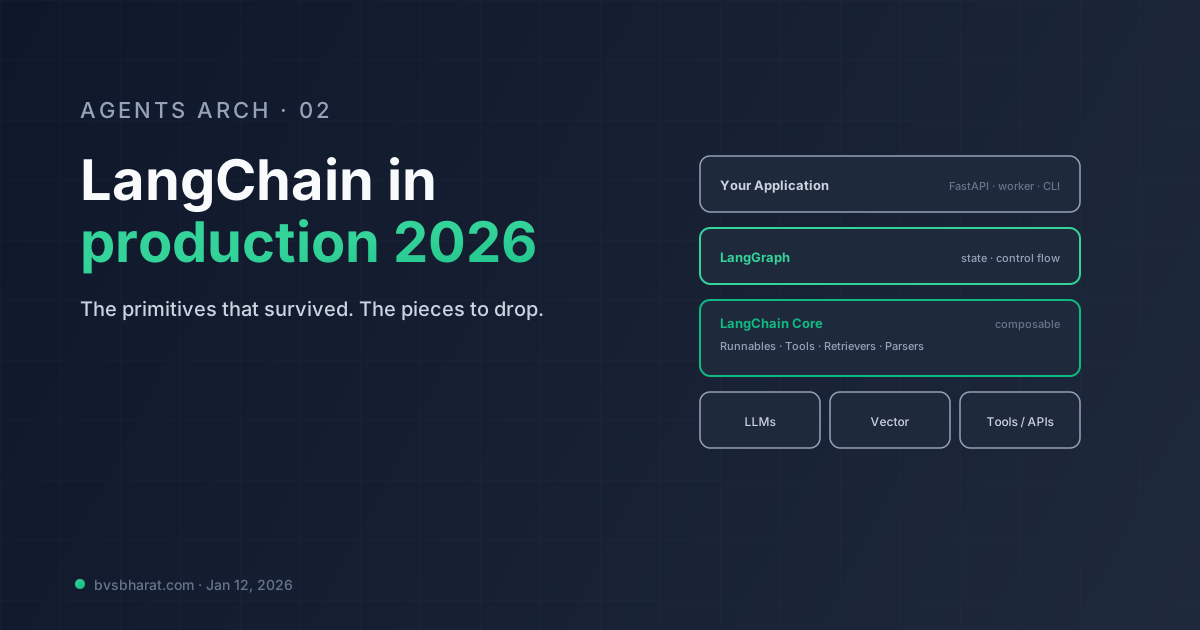
LangChain’s reputation has been on a rollercoaster: hottest framework of 2023, “is LangChain even good?” of 2024, then quietly reborn in 2025 as the layer underneath LangGraph, LangSmith, and a dozen production stacks. By 2026 the question is no longer whether you use LangChain — most production agent stacks pull it in transitively — but which primitives to use directly and which to ignore.
This post is the honest map of LangChain in 2026: what’s load-bearing, what’s deprecated, and how to compose the survivors into something maintainable.
The new mental model: LangChain as primitives, LangGraph as control flow
For two years the framework tried to be both the building blocks and the agent runtime. The agent runtime piece — AgentExecutor, initialize_agent, the function-calling agent variants — was the wobbly part. LangGraph subsumed it. What remains in LangChain proper is what was always strong: a typed, composable interface over models, tools, retrievers, parsers, and prompts.
The mental model that works:
LangGraph sits on top of LangChain Core. Your agent’s control flow lives in LangGraph (Post 3 covers this in detail). Its building blocks — model wrappers, retrievers, parsers, the LCEL composition primitives — come from LangChain.
The four primitives worth knowing
1. Runnables and LCEL
Runnable is the single interface every LangChain object implements. It has invoke, batch, stream, and async variants, and it composes with |. LCEL (LangChain Expression Language) is just operator overloading on Runnable, but it’s what makes the rest of the library readable:
from langchain_core.prompts import ChatPromptTemplate
from langchain_anthropic import ChatAnthropic
from langchain_core.output_parsers import StrOutputParser

prompt = ChatPromptTemplate.from_messages([
    ("system", "You extract the SQL intent from a user question. Be terse."),
    ("user", "{question}"),
])

chain = prompt | ChatAnthropic(model="claude-opus-4-7") | StrOutputParser()

intent = await chain.ainvoke({"question": "show me Q4 revenue by region"})
Three things to notice. The chain is typed end-to-end. It streams without code changes (async for token in chain.astream(...)). And it’s a single Runnable that you can wrap inside a LangGraph node, expose as a tool, or compose into a larger chain. This is the part of LangChain that aged well.
2. Tools
The @tool decorator turns a Python function into a callable the LLM can invoke. The signature and docstring become the JSON schema. Modern LangChain (>=0.3) generates tool schemas that match the function-calling APIs of Anthropic, OpenAI, Google, and Bedrock without manual translation:
from langchain_core.tools import tool
from pydantic import BaseModel, Field

class LookupArgs(BaseModel):
    customer_id: str = Field(description="UUID of the customer")
    since: str = Field(description="ISO date, lower bound for invoice query")

@tool(args_schema=LookupArgs)
def list_invoices(customer_id: str, since: str) -> list[dict]:
    """List invoices for a customer since a given date. Returns at most 50."""
    return billing.list_invoices(customer_id, since=since)
The Pydantic model is the contract the LLM reads. The body is your business logic. Bind a list of tools to a model with .bind_tools([...]) and you have a function-calling agent — but don’t run it with AgentExecutor; run it inside a LangGraph node where you control the loop.
3. Retrievers
A retriever is anything that implements BaseRetriever: given a query, return a list of Documents. The interface is intentionally narrow so you can plug in vector stores, BM25 indexes, knowledge graphs, web search, or a hybrid that fuses several. The 2026 winner pattern is EnsembleRetriever wrapping a vector store and a BM25 retriever with Reciprocal Rank Fusion — exactly the hybrid retrieval the memory benchmarks reward:
from langchain.retrievers import EnsembleRetriever
from langchain_community.retrievers import BM25Retriever
from langchain_postgres import PGVector

vector = PGVector(...).as_retriever(search_kwargs={"k": 10})
bm25 = BM25Retriever.from_documents(docs, k=10)
retriever = EnsembleRetriever(retrievers=[vector, bm25], weights=[0.6, 0.4])
We’ll go deep on retrieval for agents in Post 11.
4. Callbacks → tracing
Callbacks are the side-channel that emits structured events for every model call, tool call, and chain step. They are the reason LangSmith and Langfuse can show you a trace tree with zero application changes — every Runnable already emits the events. Turn on tracing by setting environment variables; the spans land in your observability backend automatically:
export LANGSMITH_TRACING=true
export LANGSMITH_API_KEY=...
export LANGSMITH_PROJECT=agents-arch-prod
If you build your own observability stack, implement BaseCallbackHandler and you have a hook for every event. Post 12 covers observability end to end.
What to drop
Three categories of LangChain code show up in old tutorials and should not be in new agents:
AgentExecutorandinitialize_agent— replaced by LangGraph. They worked for demos and fell apart at production scale because the loop, the state, and the error handling were all hidden inside the executor.- Untyped chains using
LLMChain/SimpleSequentialChain— replaced by LCEL pipelines andRunnable.with_structured_output(). The old chains had no streaming, no batching, no async, and no typed I/O. - Memory classes inside chains (
ConversationBufferMemory,ConversationSummaryMemory, etc.) — moved into LangGraph’s checkpointing system. Chain-local memory was always a leak; agent-level state is where conversation history belongs.
If you inherit a codebase using these, the migration path is straightforward: wrap the existing prompt-and-model pieces as a Runnable, put them inside a LangGraph node, and move history into the graph state. Don’t rewrite the world; replace one node at a time.
A minimal production-shaped composition
Here’s what a small but real LangChain composition looks like in 2026 — typed, async, traced, and embeddable inside a LangGraph node:
from langchain_core.prompts import ChatPromptTemplate
from langchain_anthropic import ChatAnthropic
from langchain_core.tools import tool
from pydantic import BaseModel

class Resolution(BaseModel):
    summary: str
    action: str
    confidence: float

@tool
def lookup_order(order_id: str) -> dict:
    """Fetch order details by ID."""
    return orders.get(order_id)

llm = ChatAnthropic(model="claude-opus-4-7", temperature=0.1).bind_tools([lookup_order])

prompt = ChatPromptTemplate.from_messages([
    ("system", "You triage support tickets. Use lookup_order when an ID appears."),
    ("placeholder", "{messages}"),
])

triage = prompt | llm

structured = ChatAnthropic(model="claude-opus-4-7").with_structured_output(Resolution)
Two Runnables. One does the tool-using triage. The other turns the result into a typed Resolution. Both stream, both batch, both emit traces. The LangGraph node that calls them is twenty lines (next post).
Decision rules
If you’re starting a new agent in 2026, the defaults that age well:
- LangChain for primitives, LangGraph for control. Don’t run the loop in LangChain; let LangGraph do it.
- LCEL over imperative chains. If you’re calling
.invoke()more than two or three times in a row, you wanted a pipe. with_structured_output()over manual JSON parsing. It uses the provider’s native structured-output mode and falls back to function calling automatically.- Tracing on from day one. A trace you didn’t have during the incident is the most expensive thing in agent engineering.
- Pin minor versions. LangChain still moves fast; lock
langchain,langchain-core, and provider packages to a known-good set in your lockfile.
Next week we put all of this inside a LangGraph state machine and watch the agent get reliable.